
Milan Design Week 2026 Woven Strata
The Rough, the Shimmer, the Grit
—Reimagining strata, minerals, and earth through woven textiles
Kawashima Selkon Textiles (Headquarters: Sakyo-ku, Kyoto; President: Akira Mitsuoka) will be exhibiting at one of the world’s largest design events, Milan Design Week, in Milan, Italy, from Monday, April 20 to Sunday, April 26, 2026.
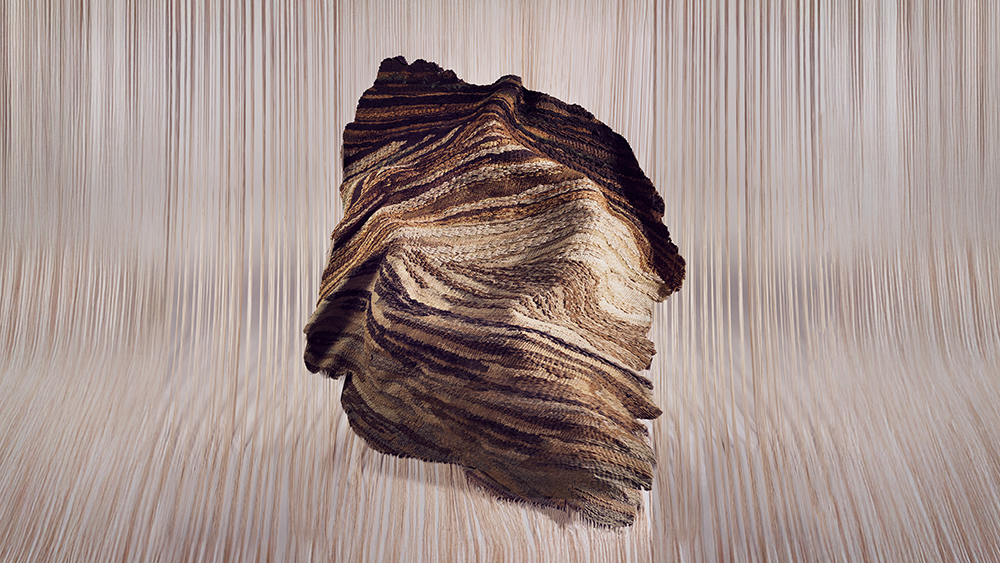
Marking its fifth participation, this year’s exhibition is themed “Woven Strata”. Formed through long processes of sedimentation, compression, and uplift, geological strata reveal cross-sections marked by uneven surfaces, granular textures, mineral flecks that shimmer in shifting light, and the rough, cracked surfaces of dried earthen walls. In this exhibition, Kawashima Selkon Textiles reinterprets these diverse textures shaped by nature’s process of sedimentation through highly advanced textile techniques refined over many decades.
From material selection and weave structure design to precise control of density, layers upon layers of processes are followed to capture inherently elusive qualities such as hardness, coarseness, and degrees of dryness as woven expressions. Rather than simply replicating natural textures, the exhibition reconstructs them within the structural framework of weaving, exploring new possibilities in textile expression.
As interest continues to grow in flexibly incorporating the feel of natural materials into architectural and interior spaces, this exhibition proposes textile interpretations of hard materials such as stone and earthen walls. While preserving their distinctive material expression, these works offer the tactile comfort unique to woven fabrics. The textiles can also be adapted for practical interior applications, including chair upholstery, cushions, and partitions.
By presenting a range of textures that can be selected according to spatial scale and lighting conditions, the exhibition introduces new possibilities for textiles that extend beyond aesthetic expression alone. Woven fabrics are positioned as “textures that play a role within the space,” able to be incorporated into design to quietly support spatial balance, boundaries, and ambience.
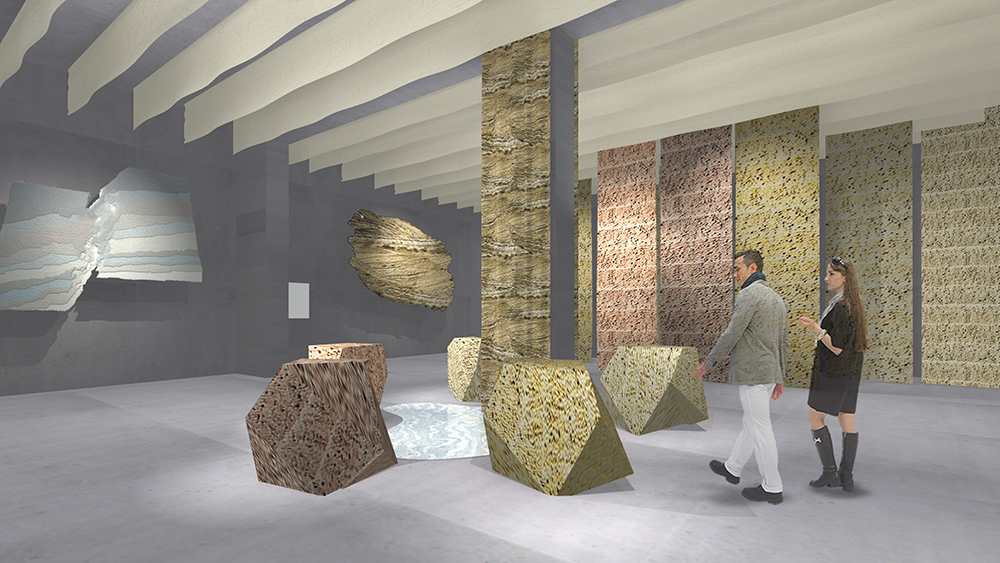
The exhibition space offers an immersive spatial experience of textures crafted through weaving techniques, inspired by geological processes such as sedimentation, compression, and uplift of strata. A wide spectrum of textile expressions comes together within a single space, ranging from powerful Tsuzure-ori tapestry artworks handwoven on giant looms by master artisans to pieces incorporating silk and gold threads, mother-of-pearl, and film, as well as practical machine-woven works that pursue materially authentic surface qualities.
With lighting designer Izumi Okayasu as art director, the exhibition invites visitors to experience the changing expressions of textiles as they shift with the angle of light and viewing distance, appealing to both vision and touch.
The expertise and spirit of experimentation of Kawashima Selkon Textiles, built up since its founding in 1843, culminate in new forms of expression in Milan.
The Two Meanings Embedded in the Theme “Woven Strata”
1.Strata of Earth × Strata of Thread
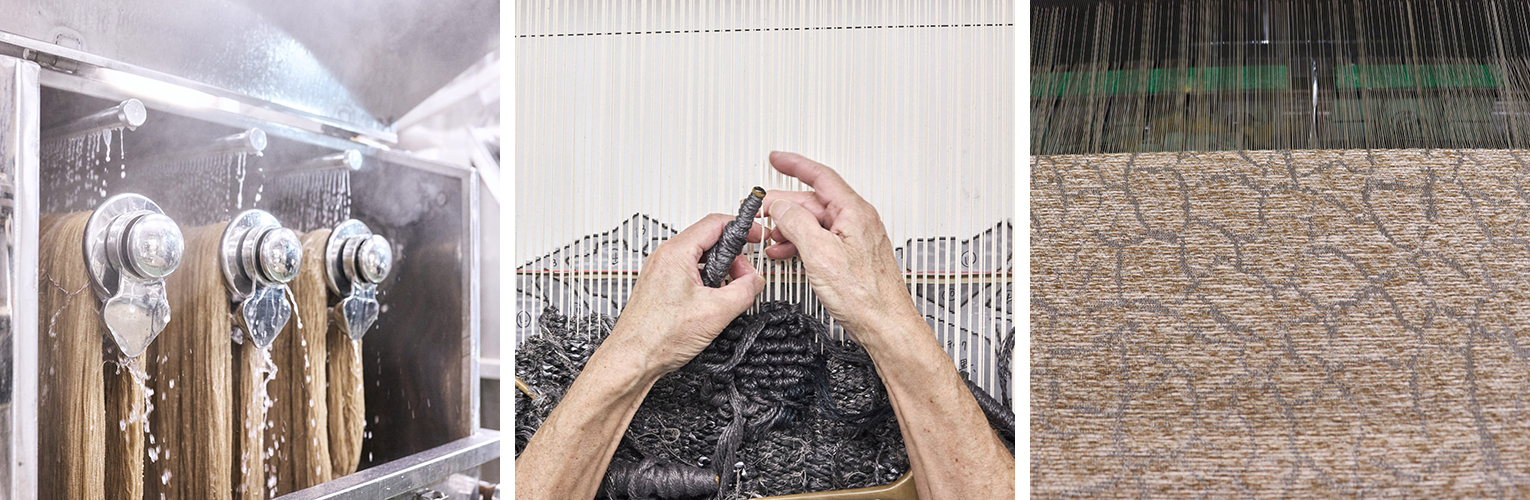
Just as geological strata and ore are formed through the accumulation of layers over long periods of time, textiles, too, are created through the layering of threads, embodying traces of time. By overlapping the natural layering of strata with the layered construction of textiles, this exhibition seeks to make visible the otherwise intangible flow and accumulation of time.
The “sedimentation” of weaving techniques since the company’s founding in 1843
Since its founding, Kawashima Selkon Textiles has continuously built upon its weaving techniques, forming its own “strata of craftsmanship.” From powerful handwoven Tsuzure-ori tapestry artworks to delicate and luminous textiles incorporating silk and gold threads, mother-of-pearl, and film, as well as practical machine-woven works that pursue realistic textures, the exhibition presents over 180 years of accumulated expertise and experimentation through a diverse range of woven expressions.
Highlights from the New Textile Collection
■Strata_1
・Dimensions: approx. H 300 × W 200 cm
・Technique: Tsuzure-ori, Nagashi-ori
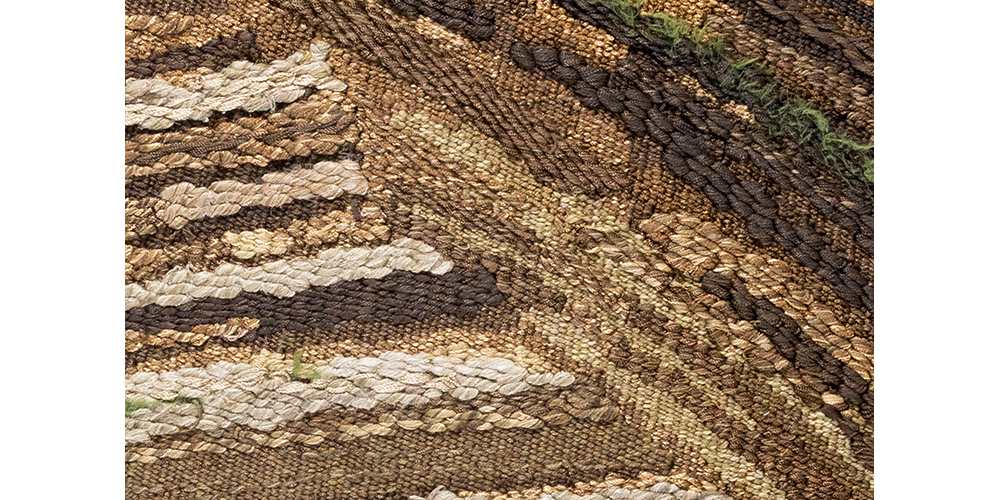
This piece is crafted using Tsuzure-ori, a weaving technique renowned for its pictorial expressiveness, in which pattern-forming weft threads are inserted by hand. Inspired by geological strata formed over long periods of time, the work expresses the layered structure of strata through weaving. Incorporating diverse materials—including hemp, paper thread, wool, and rayon—it combines variations in thread thickness and weave structure, layering distinct woven lines in multiple strata. The result is a textile surface with depth and rhythm that evokes the accumulation of time.
■Onyx_4
・Dimensions: approx. H 30 × W 30 cm
・Technique: Jacquard weaving, Photographic Hikihaku
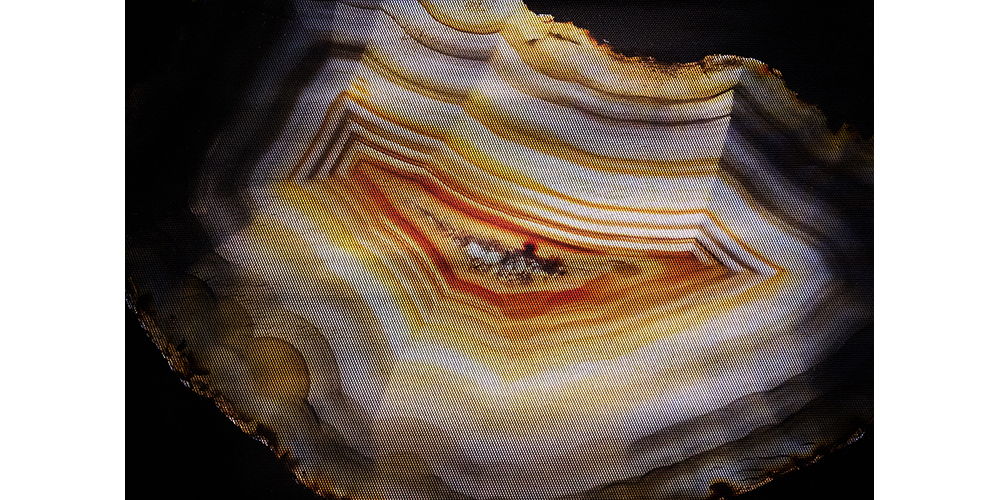
This piece is crafted using a signature Nishijin-ori weaving technique called Hikihaku, which uses weft threads that are made by finely cutting washi paper embellished with materials such as gold, silver, or lacquer into threads. Taking a cross-section of onyx as its motif, the work convincingly recreates the ore’s translucency and vivid, lustrous colors, achieving a woven texture with depth that shifts expression with the changing reflection of light.
■Soil_2
・Dimensions: approx. H 400 × W 120 cm
・Technique: Jacquard weaving
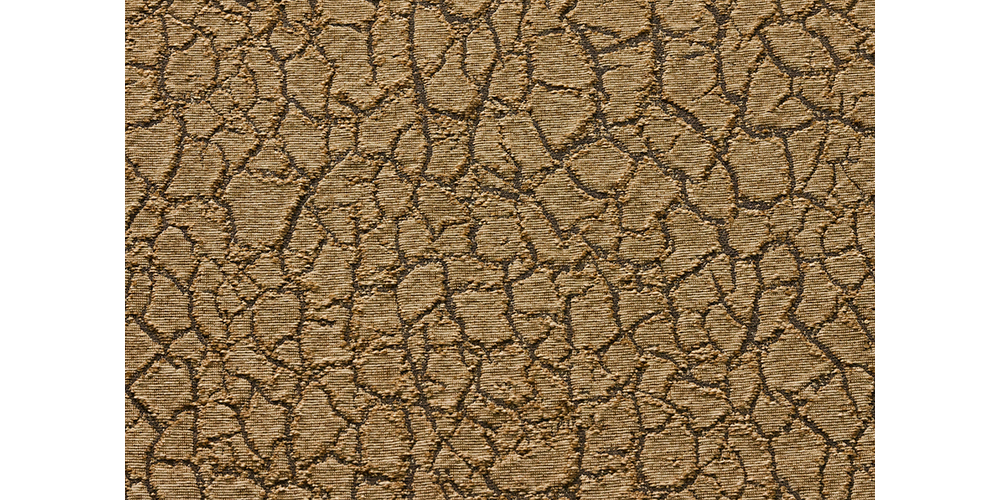
This piece embodies the character of dry, cracked earthen walls through Jacquard weaving. The dry texture is achieved with polyester novelty thread, while the irregular surfaces are woven using the Futsu-ori weaving technique, in which two types of fabric are woven together in a tube-like structure. It conveys a sense of ruggedness while preserving the inherent softness unique to textiles.
■Onyx_5
・Dimensions: approx. H 600 × W 200 cm
・Technique: Tufted, Continuous dyeing
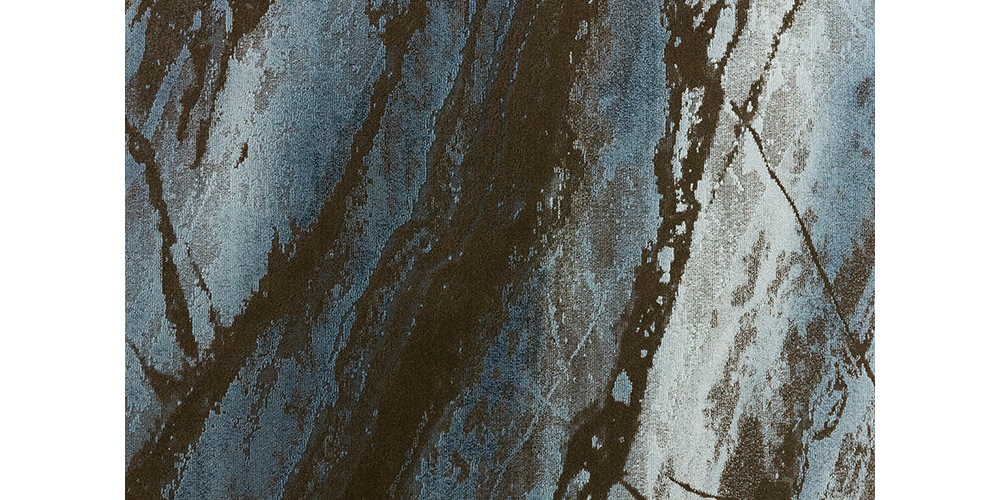
This piece portrays the mesmerizing translucency and serene beauty of onyx. Two colors of dye are poured onto a delicate, stone-grained base fabric crafted through tufting, creating a gradation to express overlapping layers. The work has a strong presence, balancing composed tranquility with a sense of boldness.
Installation: Woven Strata — Kawashima Selkon Textiles & Izumi Okayasu
For this installation, lighting designer Izumi Okayasu joins as Art Director to create a space where the very textures of the textiles are brought to life through the play of light. Visitors are invited to experience the textiles not only visually, as their appearance changes through the reflection or absorption of light and expressions shift when viewed from near or far, but also through touch.
Art Director: Izumi Okayasu
Message from the Art Director
“Sedimentation” refers to the natural process by which soil, sand, and organic matter accumulate in places where the transporting force of water or wind has weakened. Over immense spans of time, this process forms strata and sedimentary rock. These strata and rocks are eventually revealed before our eyes by powerful forces such as crustal movements, erosion by water, or excavation. Once exposed, they again undergo gradual erosion by rain and weathering by wind over time. When we encounter a cross-section of strata or sedimentary rock, we are often witnessing a moment within this ongoing process.
The exhibition brings together textiles crafted around the theme of “sedimentation” and is conceived as a landscape that evokes the slow erosion and weathering of what has been exposed. Within this landscape, we invite visitors to experience the diversity of techniques as well as the artistry of weaving on display, and to carry these impressions with them as lasting memories.
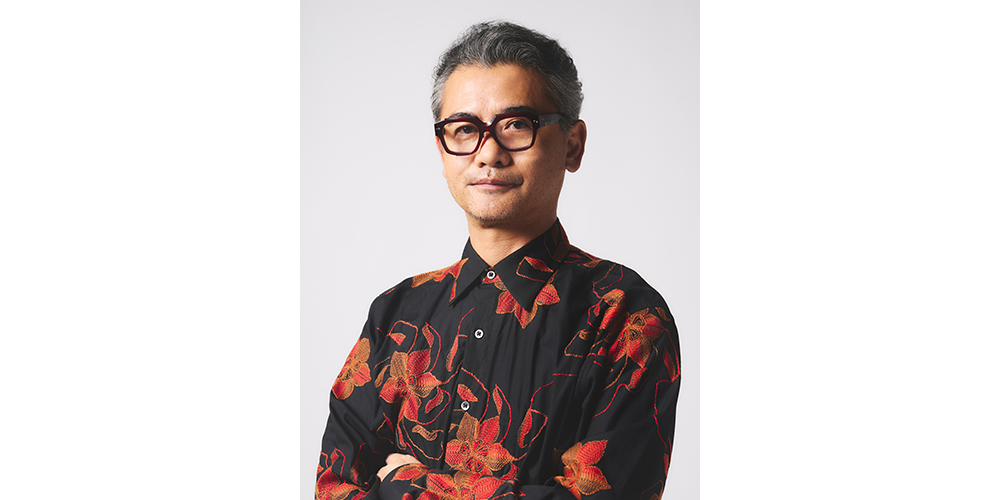
Izumi Okayasu works across all aspects of lighting design, including lighting planning for architectural and commercial spaces, lighting fixture design, and installations, both in Japan and internationally. Past projects include lighting design for Jun Aoki’s White Church, the exhibition “TOYO ITO: GENERATIVE ORDER”, Kengo Kuma’s Asakusa Culture Tourist Information Center, and Riken Yamamoto’s Namics Techno Core, as well as numerous installations for exhibitions such as Milan Design Week.
Exhibition Overview
| Theme | Woven Strata The Rough, the Shimmer, the Grit —reimagining geological strata, ore, and earth through woven textiles |
| Opening Hours | April 20 (Mon) – 26 (Sun), 2026 – Apr 20 15:00–19:00 – Apr 21–25 10:00–21:00 – Apr 26 10:00–19:00 |
| Venue | Paola Lenti Milano https://www.paolalenti-milano.it/en/ (Address: via Giovanni Bovio, 28 20159 Milano, Italy)MAP |
| Exhibition Area | Approx. 110㎡ |
| Art Direction | Izumi Okayasu (Izumi Okayasu Lighting Design) |
| Event Page | https://www.kawashimaselkon.co.jp/event/milan2026/ |
Paola Lenti
Paola Lenti is a family-owned company founded in 1994 in Meda, Italy, by graphic designer Paola Lenti. The brand develops furniture, rugs, shading systems, and architectural structures for indoor and outdoor spaces, with a strong focus on material research and distinctive color experimentation. Its collections are internationally recognized for durability, performance, and a refined aesthetic that bridges exterior and interior environments.
Kawashima Selkon Textiles
Established in Kyoto in 1843, Kawashima Selkon Textiles is a textile manufacturer now in its 184th year. Having supplied woven fabrics to the Meiji Palace in bygone eras and, more recently, to the Kyoto State Guest House and numerous luxury hotels, the company is renowned for the unparalleled quality and expressive power of its textiles.
Alongside traditional handweaving techniques upheld by master artisans, Kawashima Selkon Textiles actively embraces machine weaving that leverages modern technology, placing strong emphasis on both the preservation of cultural heritage and the pursuit of technological innovation that connects to the future. In 2019, the company launched “Weaver’s Quest”, a project that embodies this ethos. Rooted in an uncompromising exploration of the expression of beauty and the possibilities of textile, the project challenges the ‘impossible’ with the aim of evolving and advancing the craft of weaving.
At its Kyoto headquarters, the company houses a textile production plant that carries out integrated production from planning and design through dyeing and weaving; the Kawashima Textile Museum, home to a collection of historically significant dyed and woven works; and the Kawashima Textile School, where weaving techniques are passed on to the next generation. The company remains steadfast in its mission to preserve, nurture, and promote the rich tapestry of textile culture.